Brewing Hope: Wife’s Coffee Talk Starts Veteran’s Healing
3-minute read
Brewing Hope: Wife’s Coffee Talk Starts Veteran’s Healing
3-minute read
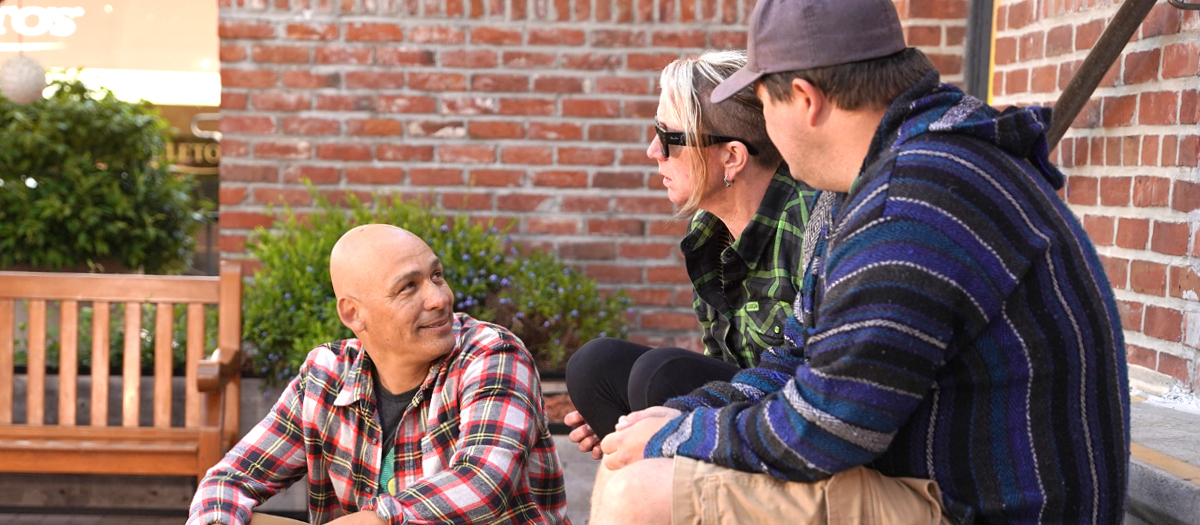
Brad’s path to managing his challenges—learning how to quiet the voice he called “the dragon”—started with a conversation the Army Veteran had with his wife over morning coffee.
“Without treatment, he was so paranoid that he couldn’t leave the house,” explains Brad’s wife, April. So during that coffee talk on their front porch, April asked Brad to go to a VA clinic to get help.
Brad recounts how timely her intervention was: “Later that day, from the clinic parking lot, I was able to call her one last time because I was suicidal and they wanted to commit me.”
“I was seeing things.” Veteran Describes Schizoaffective Disorder
Hearing things that didn’t exist
Brad served in the Army for 14 years—10 of them as a combat engineer and 4 as a mathematician. Joining the service fulfilled his desire to serve his nation when the Iraq War began in 2003. But his military career didn’t end the way he wanted it to.
“I was hearing things. I was seeing things. I was extremely paranoid,” he says. “I would hear what I later named ‘the dragon.’ It knew every chink in my armor and knew how to break me down very well.” The Army initiated a military medical board process that lasted about 18 months.
“It was a big challenge to be medically retired,” Brad continues. “It was a long time coming and it made me feel like I wasn't worth very much at all.”
Regrounding himself in reality
Out of the service and persuaded by his wife to visit the clinic, Brad began 30 days of intensive inpatient treatment for schizoaffective disorder. The condition involves features of schizophrenia and a mood disorder, such as bipolar disorder.
During his inpatient treatment, health care providers helped Brad find a balance of medications that proved effective for him. Talk therapy led to more progress. “Having a true empathetic therapist, it can save a life,” he says.
“Pharmaceuticals are my first line of defense,” Brad adds. “Therapy is the next.”
Gaining strength from family
The third line of defense is his support system, especially April.
“My wife, who is my caregiver through the VA, she keeps me as level as I can possibly be,” Brad says. A VA caregiver is a family member, friend, or professional who supports a Veteran who needs help with daily activities as the result of a service-connected injury or illness. VA provides caregiver training and support.
As Brad’s caregiver, April sees how important it is for Brad to stay on course.
“It’s because of the treatment and the stability that brings and the medication and, you know, it’s not just one building block,” she says. “It’s all different things that build a base of stability.”
As his wife, April sees firsthand the impact ongoing treatment has on Brad’s daily life, and she’s proud every day of the effort he puts in. “I know how hard he fights every single day to show up and be a husband and to show up and be a father,” she says.
Family relationships are also a powerful motivator for Brad.
“You need to work closely and honestly with your providers because there are people out there that care about you,” he says. “And for the sake of them, you need to get help.”